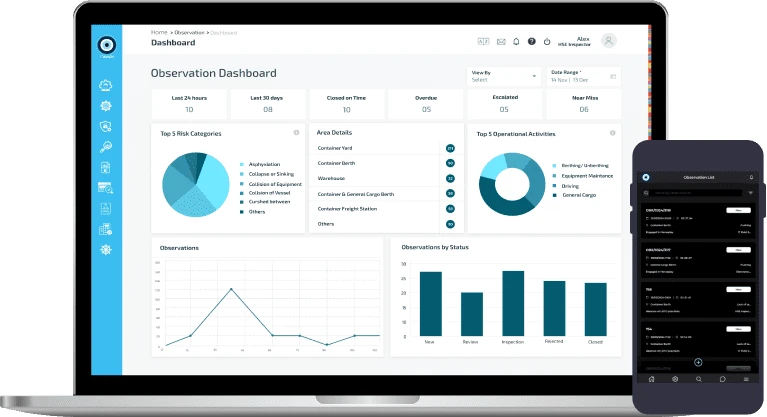
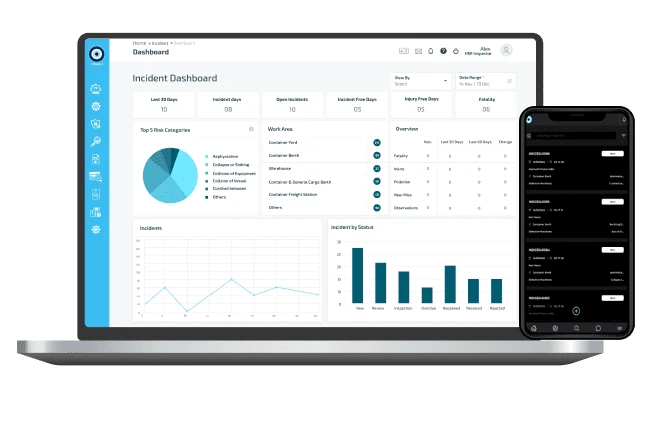
Proposed demo: offline terminal observation
- Prepare the mobile app and disconnect a test device.
- Capture an observation and incident with permitted test attachments.
- Reconnect, inspect record integrity and assign follow-up.
Qavach combines observations, investigations, risk records and actions for ports and container terminals. The Qavach.AI offering adds pattern analysis and assistants using terminal information. Separate demonstrated workflow functions from unvalidated predictions before procurement.
Built from vendor sources checked ; AI-assisted drafting. Documentation review, not a hands-on test. How pages are made
Ports, container terminals and inland depots seeking domain-specific HSE workflows. Vendor pages use strong autonomous, predictive and preventive claims, including 30-day trajectories, prescribed barriers and media-triggered violation or incident records. No independent accuracy, false-alert, prevention or ROI validation was established. Treat outputs as decision support until tested on representative terminal data, camera positions and operating conditions. The published privacy policy is a website policy, not sufficient evidence of product data processing, video surveillance, retention, biometric handling or cross-terminal model isolation. Roadmap items are not current entitlement.
Worth evaluating for terminals that would otherwise configure industry-specific workflows from scratch. Balance that fit against the minimum licence footprint and the cost of modules, integrations and AI validation.
Trial or demo on request. Sources checked .
Vendor visuals—not a QHSEtech hands-on test.
Qavach is Quantum BSO's modular QHSE platform for ports, container terminals, inland depots and related facilities. Qavach.AI is the vendor's pattern-intelligence layer and named assistants, not a standalone proof that every Qavach Core, Safety, Additional or roadmap module is licensed. It is unrelated to similarly named Kavach security products.
| Capability | Evidence | Scope and source |
|---|---|---|
| Observation capture | Documented by vendor | Observations can be categorized, reviewed and escalated into near-miss follow-up. Observation workflow |
| Terminal risk workflow | Documented by vendor | The overview links incident information, risk records and corrective action processes. Terminal HSE overview |
| Permit workflows | Depends on scope | The optional safety portfolio describes permit review, approval and closeout configuration. Confirm purchased scope. Optional safety modules |
| AI pattern analysis | Depends on scope | The vendor markets pattern clustering and Ask QAI/Polaris assistants. Prediction quality and intervention effectiveness were not independently established. AI product scope |
| Offline mobile capture | Depends on scope | Offline Observation and Incident functions are documented; other workflows are not established as offline. Mobile, hosting and API FAQ |
| Integration services | Depends on scope | The FAQ describes API integrations subject to feasibility and time-and-material fees. Mobile, hosting and API FAQ |
| Incident-to-action workflow | Documented by vendor | Qavach documents incident reporting, investigation, risk profiling, root-cause analysis, action and closure, with multimedia evidence, notifications and dashboards. Buyers should configure event taxonomy, mandatory review and regulatory reporting rather than assume a universal terminal procedure. Incident lifecycle, notifications and reporting |
| Scheduled inspections and evidence | Documented by vendor | The inspection module supports scheduling, predefined or configurable checklists, previous-event context, witness statements and image, video, voice-note, schematic and annotation evidence. Verify device support, file limits, retention and whether offline inspection is included. Inspection scheduling, evidence and checklists |
| System-assisted root-cause analysis | Depends on scope | The vendor describes multiple RCA techniques, automated findings for lower-criticality or repeat events, and group analysis for critical incidents. Do not allow an unmanned result to replace competent investigation; test evidence linkage, override and approval controls. Root-cause methods, automation and group-analysis boundary |
| Corrective action and effectiveness review | Documented by vendor | Actions can be associated with events, configured across departments, costed and checked against later similar events for effectiveness. The system's proposed actions and claimed preventive effect require human ownership and outcome review. Action management, effectiveness checks and costing |
| Alerts, reminders and escalation | Documented by vendor | Incident and action pages describe calendar-driven workflows with alerts, notifications, reminders and escalations. Confirm delivery channels, acknowledgement, after-hours routing and what happens during integration or mobile outages. Incident lifecycle, notifications and reportingAction management, effectiveness checks and costing |
| Dashboards and scheduled reporting | Documented by vendor | The platform pages describe cross-module dashboards, KPIs, trend and exception reporting, and scheduled or on-demand publishing. Validate metric definitions, role filtering, export formats and the distinction between operational reporting and regulator-ready submissions. Terminal HSE overviewCore, Safety and Additional module boundaries |
1 additional areas. Status describes reviewed sources, not hands-on performance.
Also watch for: No public numeric subscription verified. Deployment scope needs a written proposal. Detection and workflow suitability require local evaluation.
Custom quote
Contact vendor. Official pricing specifies a baseline of 20 named employee licences, annual terms and core plus optional modules. No numeric licence price or currency is public in the reviewed pages. The FAQ also identifies annual maintenance and separately scoped integration work. Confirm app and analytics units, AI entitlement, contractor access, hosting and export fees.
Pricing sources checked : Selected sources checked; no starting price recorded. Official commercial pages reviewed. No numeric subscription or unrestricted free trial established; request a scoped proposal and clarify any paid pilot.
Terminal-focused QHSE workflows spanning observations, incidents, inspections, risk, root-cause and actions, with separately scoped Safety and Additional modules and a marketed Qavach.AI layer for patterns, media signals, predictions and assistants. Confirm licensed modules, cameras and integrations, hosting, AI data boundaries and human-control design in writing.
Ask the vendor to identify the product, region, modules, billing unit, contract term and included services in writing.
The official FAQ documents offline Observation and Incident features in the mobile app. Require a demonstration of attachments, preloading, synchronization and duplicate handling.
Its documented specialization is ports and terminals. Compare its terminology and processes with your operation before choosing it for a different industry.
The pricing page states a baseline of 20 named employee licences and annual terms. Confirm app, analytics, AI and optional module entitlements in the proposal.
The FAQ names Observation and Incident as offline mobile features. Test attachment handling and later synchronization; this is not evidence that permits or AI assistance work offline.
No such guarantee is established by this research. Treat patterns and recommended barriers as decision support, with source traceability and responsible human approval.
No. Quantum distinguishes baseline Core modules, separately selectable Safety and Additional modules, and a roadmap of future areas. Require a module-by-module entitlement schedule, including Qavach.AI and mobile or BI units.
No independent predictive-accuracy evidence was established. The vendor markets patterns, clusters and 30-day trajectories; buyers should validate outputs on representative local data and keep accountable humans in control.
The official AI page says video, image, proximity, intrusion, smoke and fire signals can drive violation or incident records. That is a vendor claim, not a site acceptance result. Confirm compatible sources, processing, accuracy, privacy and review workflow in a pilot.
The RCA page describes automated analysis for simple or repeat lower-risk events and group analysis for critical incidents. Configure severity gates, required evidence, human approval and override history before production use.
The reviewed page is a general website privacy policy and is not sufficient product-processing documentation. Obtain the product DPA, subprocessors, hosting regions, retention schedule and controls for media, identifiers and cross-terminal analytics.
Drawn from the profiles behind the Alternatives list above: most category tags shared with Qavach.AI first, then the closest overlap in documented capability names, then A to Z. Ratings, search demand and sponsorship are not used; rows are shown A to Z.
Shared category tags: 1 (Incident Management).
Differs: trial not established (this profile: on request).
Same: scope, offline and price.
Shared category tags: 1 (Risk Assessment).
Differs: offline unclassified (this profile: partial workflow); trial not established (this profile: on request).
Same: scope and price.
Shared category tags: 2 (EHS Management, Incident Management).
Differs: trial not established (this profile: on request).
Same: scope, offline and price.
Also recorded as Qavach. Older entries under a previous name may describe a different release or owner.
Star ratings and review counts from the old catalog are not shown: no source for them was recorded.