QHSEtech

    Enterprise Health

    Enterprise Health combines occupational-health and compliance workflows with clinical records, surveillance panels, immunization, injury and illness case management, employee or supervisor portals, reporting and integrations. The application is built on the ONC-ACB-certified WebChart platform, but the vendor explicitly states that Enterprise Health itself is not ONC-ACB certified. Buyers should validate the exact clinical, privacy, regulatory and interface scope and preserve qualified human authority for clinical fitness, recordability, treatment and employment decisions.

    Evidence: Researched profile

    Built from vendor sources checked ; AI-assisted drafting. Documentation review, not a hands-on test. How pages are made

    Who is Enterprise Health for?

    Large employers, health systems, government programs and occupational-medicine providers evaluating a configurable occupational and employee health record with surveillance and interfaces. Configuration, automated forms, alerts or portal labels do not prove legal compliance, clinical correctness or appropriate employer access. Test every role, field, attachment, search, export, notification and interface with fictional sensitive records, and retain clinician, privacy, safety and legal review authority.

    Consider Enterprise Health when the requirement extends beyond EHS recordkeeping into governed occupational-health clinical workflows, surveillance and interoperability. Before rollout, prove role boundaries, auditability, one high-risk regulatory workflow and one required interface using fictional records; do not rely on product configuration as a substitute for clinical or legal validation.

    Sources checked .

    Product tour

    Vendor visuals—not a QHSEtech hands-on test.

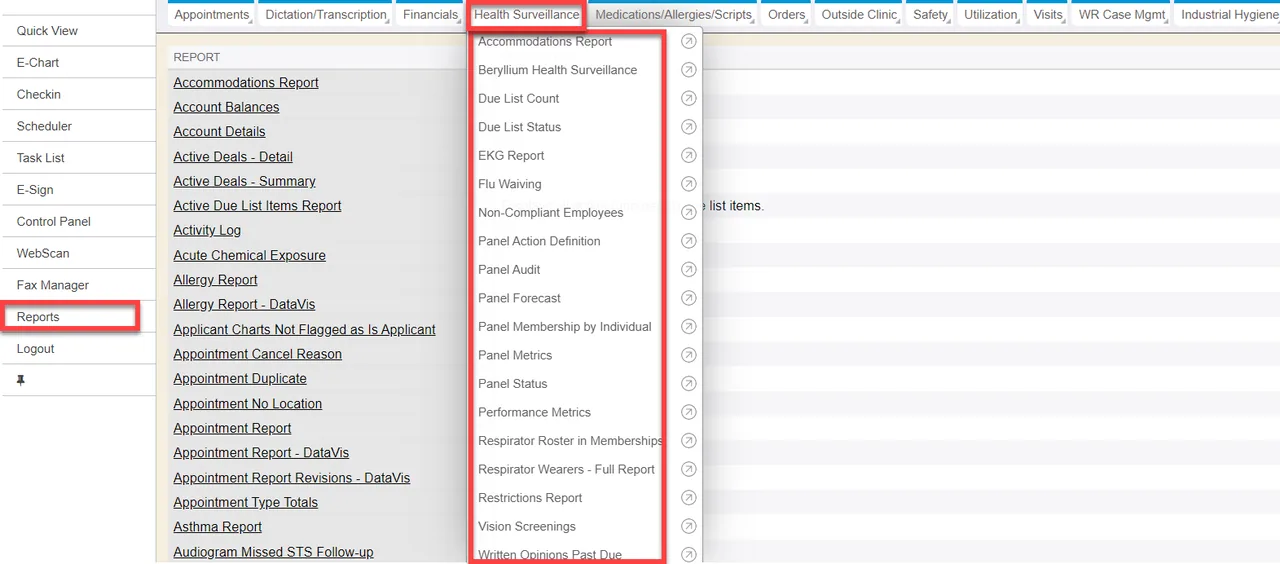
    Reports page with a Health Surveillance menu listing reports such as Due List Count, Panel Status, Respirator Wearers and Vision Screenings.

    Health Surveillance reports menu

    Source
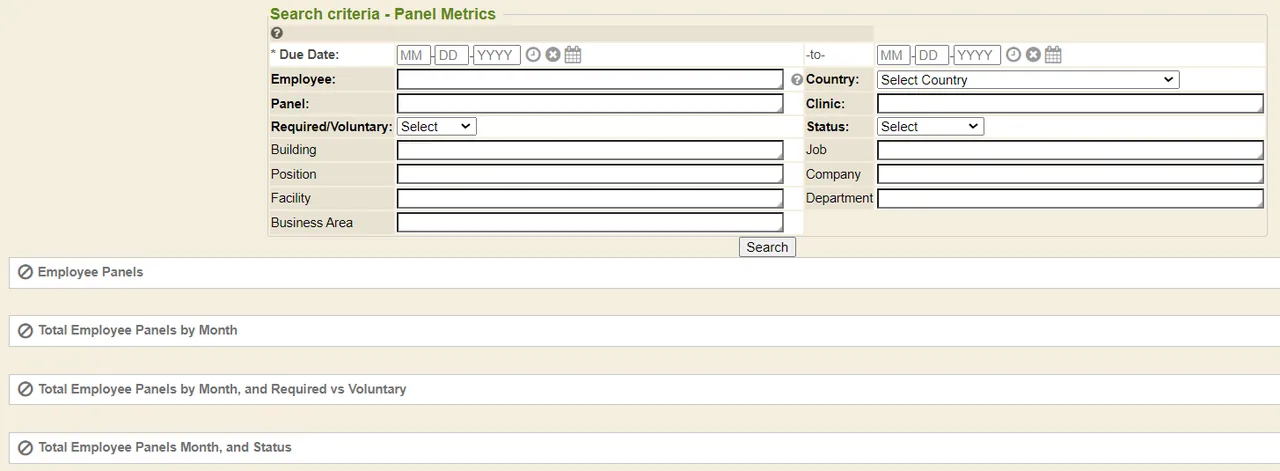
    Search criteria form for Panel Metrics with due date, employee, panel, status and location fields and collapsed result sections by month.

    Panel Metrics report search criteria

    Source

    Capabilities and scope

    This profile covers the Enterprise Health occupational and employee health software platform, including its clinical record, surveillance, injury, portal and interoperability functions.

    Enterprise Health capabilities, evidence status and source links
    CapabilityEvidenceScope and source
    Occupational and employee clinical recordDocumented by vendor

    The platform documents occupational-health encounters, clinical records, orders, results, restrictions and other employee-health information. Software scope does not establish who provides care, owns the record or makes clinical and employment decisions.

    Enterprise Health product features: occupational health, clinical care, portals, reporting, interoperability, hosting and certification caveatsEnterprise Health federal solution: longitudinal employee health record, role-based access, audit logging and interoperability claims
    Medical surveillance panels and due-status trackingDocumented by vendor

    Official material covers audiometry, pulmonary function, vision, respirator-fit and other surveillance exams, questionnaires, panels, reminders and reporting. Buyers must configure exposure logic, frequency and eligibility against their approved program.

    Enterprise Health product features: occupational health, clinical care, portals, reporting, interoperability, hosting and certification caveatsEnterprise Health documentation: medical surveillance program and occupational-health recordkeeping workflowEnterprise Health documentation: health-surveillance reports and respirator roster scope
    Workplace injury and illness case managementDocumented by vendor

    The product page describes encounters, case fields, lost-time tracking, work restrictions, workers' compensation and OSHA-oriented forms or logs. Recordability, causation, treatment and reporting decisions remain accountable buyer judgments.

    Enterprise Health product features: occupational health, clinical care, portals, reporting, interoperability, hosting and certification caveats
    Immunization and mass-clinic workflowsDocumented by vendor

    The platform documents consent or declination forms, questionnaires, clinical alerts, high-volume administration and registry interfaces. Clinical screening, consent validity, inventory reconciliation and reporting rules require local validation.

    Enterprise Health product features: occupational health, clinical care, portals, reporting, interoperability, hosting and certification caveats
    Employee and supervisor portalsDepends on scope

    Employee self-service and supervisor views of work or surveillance status are documented. The exact data visible through portals, search, notifications, attachments and export depends on role, relationship and configuration and must be privacy-tested.

    Enterprise Health product features: occupational health, clinical care, portals, reporting, interoperability, hosting and certification caveatsEnterprise Health documentation: supervisor portal setup and SSO contextEnterprise Health documentation: security-role settings and configurable access permissions
    Role-based access and patient relationshipsDepends on scope

    Documentation describes department, individual and portal-restricted security roles and relationship-based chart access. Effective least privilege depends on configuration, exception handling, emergency access, periodic review and termination controls.

    Enterprise Health documentation: security-role settings and configurable access permissionsEnterprise Health documentation: user access, audit-log review, lock records and user revisions
    Audit logging and access reviewDocumented by vendor

    Official documentation describes privileged searches of user activity, chart views or edits, event outcomes, click details, locks and user revisions. Confirm retention, completeness, alerting, immutable export and review responsibility in the proposed deployment.

    Enterprise Health documentation: activity-log reporting and privileged audit reviewEnterprise Health documentation: user access, audit-log review, lock records and user revisions
    Standard, custom and regulatory-oriented reportingDepends on scope

    The vendor documents dashboards, custom reports, CSV export and OSHA-oriented forms and logs. These functions support recordkeeping but do not guarantee data accuracy, recordability decisions, filing acceptance or compliance in every jurisdiction.

    Enterprise Health product features: occupational health, clinical care, portals, reporting, interoperability, hosting and certification caveatsEnterprise Health documentation: health-surveillance reports and respirator roster scope
    HR, laboratory, device and external-system interoperabilityDepends on scope

    The vendor lists bidirectional integrations with HR, laboratories, medical devices, registries, workers' compensation and other systems. Each interface requires contracted scope, identity matching, code mapping, clinical validation, monitoring and ownership.

    Enterprise Health product features: occupational health, clinical care, portals, reporting, interoperability, hosting and certification caveatsEnterprise Health FAQ: deployment, hosting, data migration, integrations, SSO, training and support
    HL7 and API-enabled exchangeDepends on scope

    Documentation describes HL7 v2 transport over TCP/IP, TLS or REST posting and states that foreign code translation may be required. Federal materials also claim HL7, FHIR, DICOM and API interoperability; exact endpoints, conformance, authentication and entitlements require validation.

    Enterprise Health documentation: HL7 v2 interface transport and translation assumptionsEnterprise Health federal solution: longitudinal employee health record, role-based access, audit logging and interoperability claims
    Migration services and validation environmentDepends on scope

    The FAQ describes vendor ETL scripts and a dedicated cloned system used for migration validation. Buyers remain responsible for source completeness, reconciliation, clinical sign-off, retention and defensible treatment of excluded legacy data.

    Enterprise Health FAQ: deployment, hosting, data migration, integrations, SSO, training and support
    Hosting options and security assuranceDepends on scope

    The vendor describes SaaS, multi-tenant or single-tenant, client data-center and commercial-cloud options, plus SOC and HITRUST claims. Obtain current reports or certification scope and map responsibilities, locations, subprocessors, resilience and breach procedures to the chosen architecture.

    Enterprise Health product features: occupational health, clinical care, portals, reporting, interoperability, hosting and certification caveatsEnterprise Health FAQ: deployment, hosting, data migration, integrations, SSO, training and supportEnterprise Health Data Privacy Framework policy

    More capability notes

    3 additional areas. Status describes reviewed sources, not hands-on performance.

    Also watch for: No comparable public subscription amount was verified. Regional clinical, regulatory and interface scope needs confirmation.

    Enterprise Health pricing

    Custom quote

    On 26 September 2026 the homepage offered Request a strategic demo and Contact routes and shows no amount; enterprisehealth.com/pricing returned an empty page and the site has no working search. Request a proposal covering employee population, clinics, named roles, migration, hosting, interfaces and support.

    Pricing sources checked : Partially verified. Official product, documentation, security, deployment, migration and demo sources were reviewed. Price, trial terms, contracted modules, current assurance reports, hosting responsibilities and regional availability need a scoped vendor response.

    Which product scope should the quote cover?

    Enterprise Health occupational and employee health software, contracted clinical modules, portals, hosting and interfaces. Clinical service delivery, jurisdiction-specific compliance interpretation and employer decision authority remain buyer-controlled responsibilities unless separately contracted.

    Ask the vendor to identify the product, region, modules, billing unit, contract term and included services in writing.

    Offline work and integrations

    Ask the vendor to demonstrate exactly which records and tasks remain available without connectivity and how unsynchronized sensitive data is protected, reconciled and audited.

    What we could not verify

    2 not verified · 8 depend on scope · 6 notes

    Demo script

    Surveillance result to clinician-approved work status

    1. Create fictional employee, clinician and supervisor identities and assign a test surveillance panel using the buyer's approved eligibility and frequency rules.
    2. Import a sample result through the proposed laboratory or device interface, including one unmatched employee and one corrected result.
    3. Have an authorized clinician review the source result, record the clinical interpretation, work restriction or clearance and next review date.
    4. Inspect the employee and supervisor portal, alerts, exports and audit log to confirm that only the minimum authorized work-status information is exposed.

    Workplace injury record to reviewed regulatory output

    1. Register a fictional injury encounter and capture clinical details, work relationship, lost time, restrictions and workers' compensation identifiers.
    2. Have qualified staff make and record the jurisdiction-specific recordability decision rather than accepting an automated form as authoritative.
    3. Generate the applicable OSHA-oriented form or log and reconcile every populated field to the approved source record.
    4. Correct one field, regenerate the output, inspect the audit trail and obtain final legal or safety review before any external filing.

    Sensitive-record access and privacy incident test

    1. Create fictional records containing an occupational restriction, primary-care note, laboratory result and sensitive attachment.
    2. Search, view, message, notify and export using clinician, employee, supervisor, administrator and unauthorized accounts.
    3. Verify relationship and role restrictions, emergency-access handling, audit events and removal of terminated-user access.
    4. Simulate an inappropriate access review and export the evidence required by the buyer's privacy incident procedure.

    Ask the vendor to show you

    1. Can a supervisor or employer user find a fictional clinical note, result or attachment through search, dashboards, exports, notifications or indirect links?
    2. Which roles, patient relationships, department rules, emergency-access paths and exceptions govern every sensitive record type?
    3. Who approves surveillance eligibility, frequency, clinical interpretation, fitness, restrictions and changes to those rules?
    4. What information, identifiers and codes cross each HR, laboratory, device, registry, workers' compensation and EHS interface?
    5. How are rejected, delayed, duplicated, corrected and unmatched interface messages detected, reconciled and audited?
    6. Which deployment, tenant, location, subprocessor, encryption, resilience, retention and incident-response controls apply to our chosen architecture?
    Use demo checklist

    Sources and change log

    14 sources, checked
    • : Expanded official-source review across clinical scope, surveillance, injury, portals, records, privacy, security, hosting and interoperability, with explicit regulatory-support and decision-authority boundaries.
    • : Re-checked on 26 September 2026: demo and contact routes only, no pricing page and no amount shown.
    • Official vendor documentation review, not hands-on clinical validation, legal advice or verified customer testimony.
    • Confirm modules, hosting, integrations, current assurance reports, regional rules and commercial terms; the application supports but does not assume clinical, privacy, regulatory, fitness or employment decision authority.

    Compare with

    Drawn from the profiles behind the Alternatives list above: most category tags shared with Enterprise Health first, then the closest overlap in documented capability names, then A to Z. Ratings, search demand and sponsorship are not used; rows are shown A to Z.

    • Civica Occupational Health

      Shared category tags: 1 (Occupational Health).

      Differs: price amount published (this profile: no verified amount).

      Same: scope, offline and trial.

    All Enterprise Health alternatives

    Reviews on qhsetech.com

    Star ratings and review counts from the old catalog are not shown: no source for them was recorded.