
    QHSEtech

    Datamaran

    Datamaran helps teams identify and prioritise external risks using disclosures, regulations and stakeholder evidence. Core supports double materiality work, while Regulatory Monitoring organises changing requirements and responsibilities. The documented workflow requires review of AI suggestions.

    Evidence: Researched profile

    Built from vendor sources checked ; AI-assisted drafting. Documentation review, not a hands-on test. How pages are made

    Who is Datamaran for?

    Enterprise sustainability, risk and legal teams maintaining materiality decisions and regulatory priorities. AI-generated IROs, regulation insights, peer comparisons, scores and thresholds are decision support, not legal opinions or automatic materiality conclusions. The company and its subject-matter experts remain responsible for business context, value-chain evidence, scoring methodology, threshold choices, applicability, action plans and approvals. Confirm Core, Regulatory Monitoring, Peer Benchmarking and Suite entitlements separately, and test whether exports preserve sources, versions, reviewer changes and decision rationale.

    Worth shortlisting when materiality reviews and regulatory monitoring recur across functions. If the immediate problem is entering utility bills and calculating emissions, first establish whether a separate operational data platform is required.

    Sources checked .

    Product tour

    Vendor visuals—not a QHSEtech hands-on test.

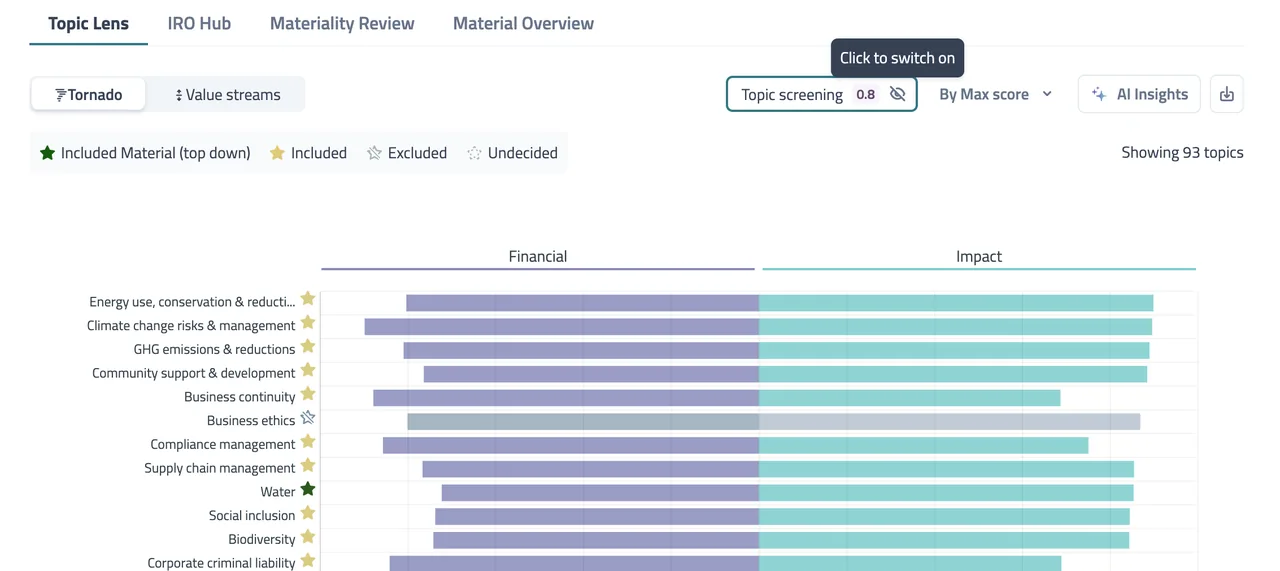
    Topic Lens tab with a tornado chart of financial and impact bars per topic, topic screening control and star status markers

    Topic Lens tornado view of scored topics

    Source
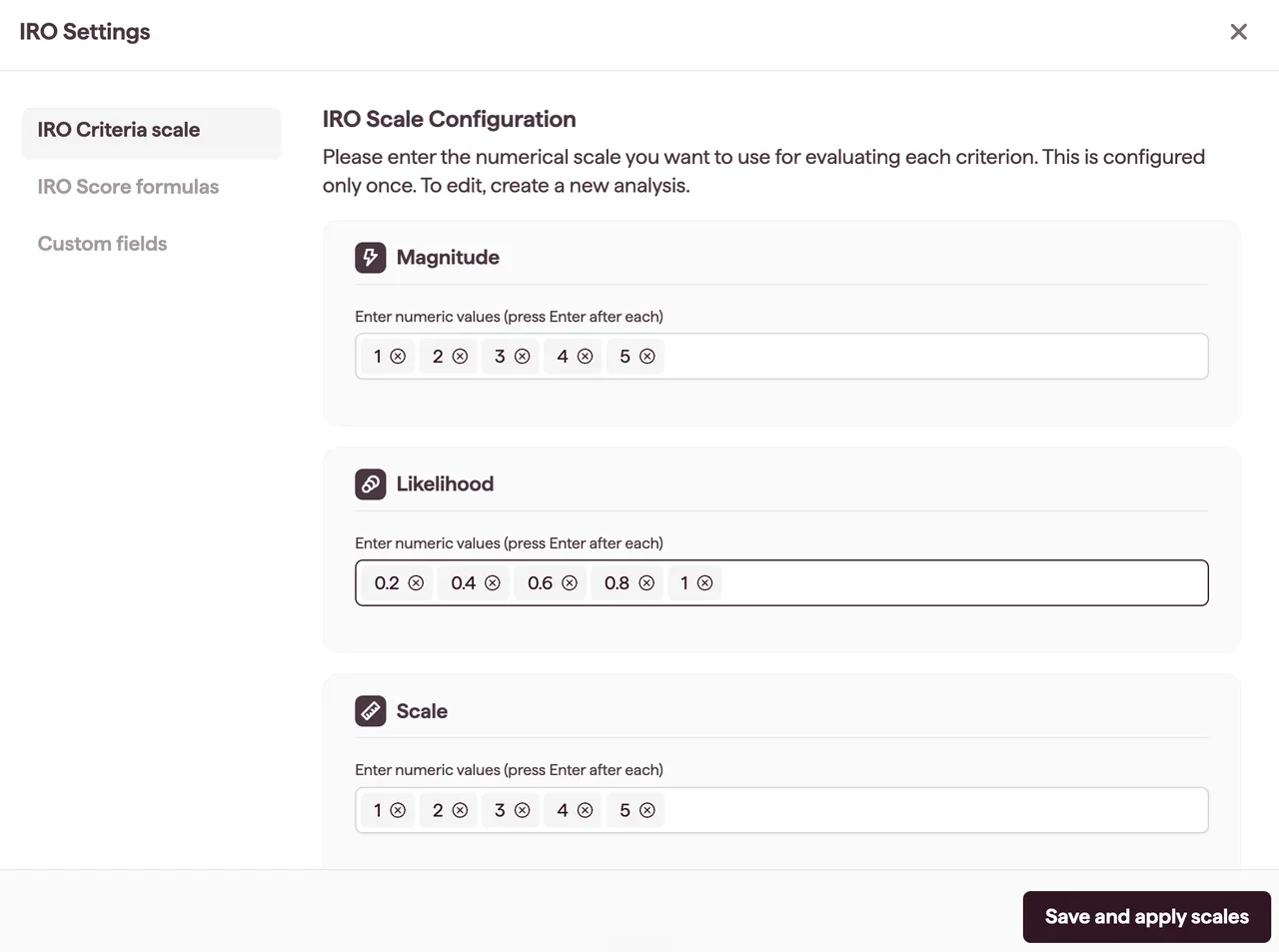
    IRO Settings dialog with numeric scale entries for magnitude, likelihood and scale criteria and a Save and apply scales button

    IRO criteria scale configuration dialog

    Source
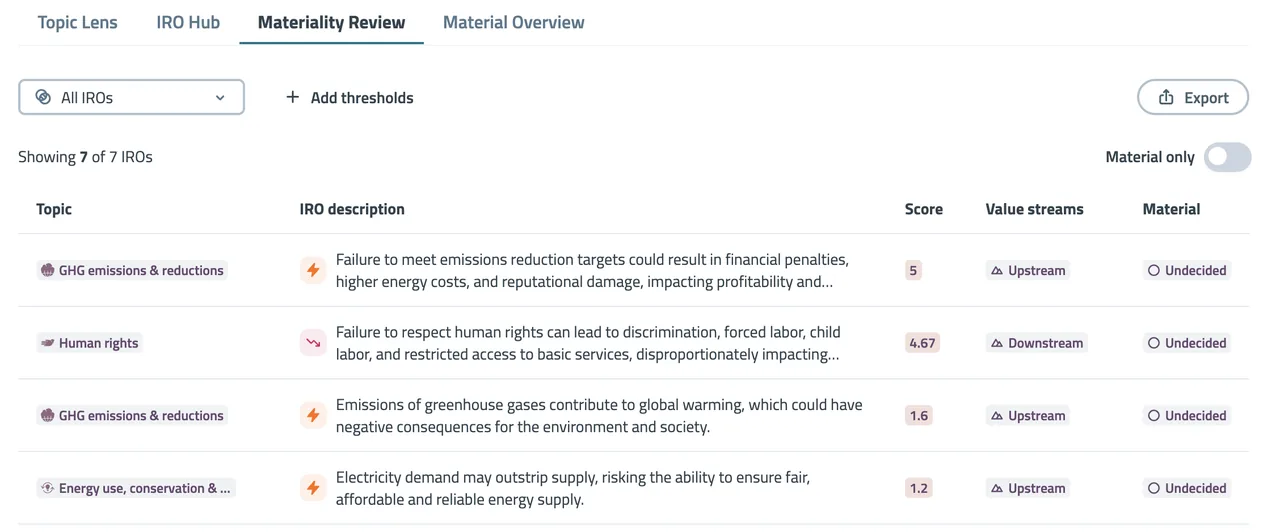
    Materiality Review tab listing impacts, risks and opportunities with topic, description, score, value stream and material status columns

    Materiality Review table of scored IROs

    Source

    Capabilities and scope

    Datamaran's current product family includes Core, Regulatory Monitoring and Suite. This profile distinguishes materiality and governance intelligence from an operational carbon accounting ledger.

    Datamaran capabilities, evidence status and source links
    CapabilityEvidenceScope and source
    Value-chain assessment setupDocumented by vendor

    The help workflow defines value streams, optional custom inputs and weights for a double materiality analysis.

    Configure a double materiality analysis
    Topic selection and rationaleDocumented by vendor

    Topic screening supports thresholds, manual inclusion or exclusion and a rationale for exclusions.

    Screen and export material topics
    AI-suggested IRO reviewDocumented by vendor

    Users can edit suggested impacts, risks and opportunities, change mappings and assign assessment to subject-matter experts. Suggested ESRS mappings require review.

    Review and edit AI-suggested IROs
    Assessment exportsDocumented by vendor

    Topic Scoring Export includes topics, scores, data sources and value-stream details. Confirm whether additional decision history is included in your chosen export.

    Screen and export material topics
    Ongoing topic monitoringDocumented by vendor

    Core describes monitoring changes to risks and opportunities and refreshing materiality conclusions. Test how a changed signal affects a previously approved decision.

    Datamaran Core
    Regulatory monitoring and ownershipDepends on scope

    The separately named Regulatory Monitoring product documents saved views, notifications, role permissions and actions. Confirm its inclusion in the contract.

    Regulatory Monitoring
    Operational carbon calculationsNot verified

    Reviewed materiality and regulatory sources do not establish an activity-based emissions ledger or utility-data collection workflow.

    Configurable IRO criteria and scoring formulasDocumented by vendor

    Datamaran documents default 1-to-5 criteria and formulas for impacts, risks and opportunities, plus custom scales and custom scoring methodologies. The organization owns the appropriateness, consistency and approval of its chosen formula; custom scales are fixed for an analysis after creation and changes may require a new analysis or support.

    IRO scoring criteria and default formulasCustom IRO criteria scalesCustom IRO score methodology and formulas
    SME assignment by email invitationDocumented by vendor

    The Double Materiality module allows subject-matter experts to be assigned by topic or individual IRO and are invited by email, with an optional deadline message. The help page does not describe the access an assigned expert receives, so buyers should test identity, visibility boundaries, deadlines, reassignment, reopening, reminders and the retained record of who submitted each judgment.

    Assigning subject-matter experts to IROsReview and edit AI-suggested IROs
    Materiality thresholds and borderline reviewDocumented by vendor

    Analysis owners can define quantitative thresholds for positive impacts, negative impacts, risks and opportunities and optionally flag scores close to the cutoff. A calculated status does not replace accountable review, qualitative evidence or documented treatment of borderline items.

    Materiality thresholds and close-to-threshold reviewIRO scoring criteria and default formulas
    Peer and topic benchmarkingDepends on scope

    Datamaran Suite presents comparisons of what peers disclose and how they frame topics across industry, geography and regulatory context. Peer disclosure is external evidence, not proof of materiality, compliance or best practice for the buyer; confirm comparator selection, periods, source documents and included entitlement.

    Datamaran Suite and Peer Benchmarking scopeDatamaran Core
    Unified governance evidence and executive reportingDepends on scope

    Suite combines materiality, regulatory monitoring and peer benchmarking into a shared evidence base with export-ready reporting and cross-functional views. Confirm that Suite is licensed, which source and change-history fields are exported, and whether downstream risk or reporting systems require custom integration.

    Datamaran Suite and Peer Benchmarking scopeRegulatory Monitoring

    Also watch for: No public subscription amount verified. Requires internal subject-matter review.

    Datamaran pricing

    Contact vendor

    Pricing is not publicly available, contact vendor. Name Core, Regulatory Monitoring or Suite in the proposal and confirm assessment scope, users, expert participation, onboarding, exports and support.

    Pricing sources checked : Partially verified. Product family and discovery-call route verified; subscription amounts and trial entitlement are not public in the reviewed sources.

    Which product scope should the quote cover?

    Datamaran provides governance intelligence rather than an operational ESG ledger. Core supports evidence-based materiality and IRO assessment; Regulatory Monitoring tracks non-financial regulatory developments and action ownership; Suite combines Core, Regulatory Monitoring and Peer Benchmarking.

    Ask the vendor to identify the product, region, modules, billing unit, contract term and included services in writing.

    Offline capability not verified

    Confirm connectivity needs and draft recovery with the vendor.

    What we could not verify

    1 not verified · 3 depend on scope · 4 notes

    Demo script

    Demo exercise: material topic with contested evidence

    1. Define an upstream and an operational value stream relevant to your business.
    2. Inspect source evidence for an included and an excluded topic.
    3. Ask a subject-matter expert to amend an AI-suggested IRO and explain the change.
    4. Export the topic list and inspect which rationale and source fields survive.

    Demo exercise: changed regulation to owned response

    1. Choose a relevant jurisdiction and regulatory topic.
    2. Review the primary source behind an alert and confirm applicability with your legal reviewer.
    3. Assign the response to a named owner in the proposed product.
    4. Show leadership the open action and the evidence supporting its status.

    Demo exercise: governed IRO scoring and threshold decision

    1. Configure the proposed criteria scale and formula, record its owner and approval, and score one impact and one financial risk using representative evidence.
    2. Assign one IRO to a subject-matter expert with limited access, submit a score and then reopen it with a documented reason.
    3. Set separate thresholds, place one IRO inside the close-to-threshold range and require a reviewer to record the final materiality judgment.
    4. Create a new analysis version after an assumption changes and export the formula, scores, evidence, reviewers, threshold and rationale for comparison with the locked prior version.

    Ask the vendor to show you

    1. Show the evidence behind one included, one excluded and one close-to-threshold topic.
    2. How do reviewers amend AI-generated IROs, regulation insights and ESRS mappings while retaining the original suggestion and rationale?
    3. Demonstrate default and custom scoring formulas, scale governance, threshold approval and the effect of a changed score.
    4. Show SME invitation, partial-access boundaries, submission, reopening and reassignment without exposing unrelated records.
    5. How do peer disclosures, regulations, market signals and stakeholder inputs remain distinguishable in the evidence base?
    6. For a changed regulation, show the primary source, proposal-to-enforcement history, applicability decision, owner, action and board-ready status.
    Use demo checklist

    Questions the sources answer

    Is Datamaran a carbon accounting platform?

    The reviewed sources focus on materiality, external risk and regulatory intelligence. They do not establish an operational emissions ledger. Confirm integration with the system that collects your activity data.

    Can people override Datamaran's AI recommendations?

    Help documentation describes editing suggested IROs and adjusting ESRS mappings. Topic inclusion can also be changed with supporting rationale. Treat suggestions as inputs to accountable review.

    Can Datamaran support a double materiality assessment?

    Core documents value-chain analysis, topic screening and IRO evaluation. Test the workflow with your own experts and assurance expectations; software support does not guarantee regulatory or audit acceptance.

    Are Core, Regulatory Monitoring and Peer Benchmarking all included?

    Do not assume so. Datamaran presents Core and Regulatory Monitoring as products, while Suite combines them with Peer Benchmarking. Require each entitlement, user role, service and export in the written proposal.

    Does Regulatory Monitoring replace legal review?

    No. It can surface developments, AI insights, lifecycle status and ownership, but qualified reviewers must verify the primary law, applicability, interpretation, deadlines and response.

    Can Datamaran collect utility data and calculate our carbon inventory?

    The reviewed sources do not establish an operational activity-data and emissions-calculation ledger. Plan the integration or handoff to the system that owns measurements, factors and reported figures.

    Sources

    13 sources, checked

    Compare with

    Drawn from the profiles behind the Alternatives list above: most category tags shared with Datamaran first, then the closest overlap in documented capability names, then A to Z. Ratings, search demand and sponsorship are not used; rows are shown A to Z.

    • Dunya Analytics

      Shared category tags: 3 (Materiality Assessment, ESG Frameworks Reporting, others).

      Differs: trial free trial documented (this profile: not established).

      Same: scope, offline and price.

    All Datamaran alternatives

    Reviews on qhsetech.com

    Reviews may be filed under other names

    Also recorded as Datamaran Core. Older entries under a previous name may describe a different release or owner.

    Star ratings and review counts from the old catalog are not shown: no source for them was recorded.