QHSEtech

    ESdat

    ESdat organizes environmental site information from field programs, laboratories, historical sources, loggers and sensors. Official documentation covers configurable QA reports, environmental-standard comparisons, maps, graphs, dashboards and data feeds. Evaluate a complete sampling event—from plan and offline capture through laboratory revision, QA review, approval and regulatory output—before treating an exceedance dashboard as decision-ready.

    Evidence: Researched profile

    Built from vendor sources checked ; AI-assisted drafting. Documentation review, not a hands-on test. How pages are made

    Who is ESdat for?

    Environmental teams and consultants managing recurring sampling programs and laboratory results. Edition, module and deployment scope materially changes the result: Field Portal is included, but offline work is a Field App capability; laboratory sample capture in the app also requires Field Management. Logger ingestion requires LoggerSync, the API carries an additional annual fee, an Enterprise OData feed carries an additional fee, and Enterprise/Server controls should not be attributed to every hosted package. Laboratory integrations vary by laboratory, and advanced eQuote/eCOC connections exist only with selected laboratories. QA reports automate configured checks but do not decide data usability: sample types, parent samples, frequencies, RPD thresholds, blanks, spikes, surrogates, holding times, qualifiers and DQOs still require specialist approval. Precompiled environmental standards are decision support, not legal advice or a compliance guarantee; ESdat explicitly places responsibility on the user to verify compiled values, applicability, units, matrix, dates and local requirements. Approval/rejection requires correct permissions, and rejected lab results can remain visible in data views unless filtered or deleted. Offline claims apply to prepared Field App workflows, not all web, lab, reporting or integration functions; pilot download scope, attachments, conflicts, failed sync and server receipt. Confirm cloud region, tenancy, Server/on-premise responsibilities, retention, backup, recovery, security evidence and every separately priced integration in writing.

    ESdat is worth investigating when the requirement is traceable environmental sampling and analysis. Use the trial to reconcile one realistic field-and-lab dataset, including an amended result and a disconnected collection step.

    Free trial documented. Sources checked .

    Product tour

    Vendor visuals—not a QHSEtech hands-on test.

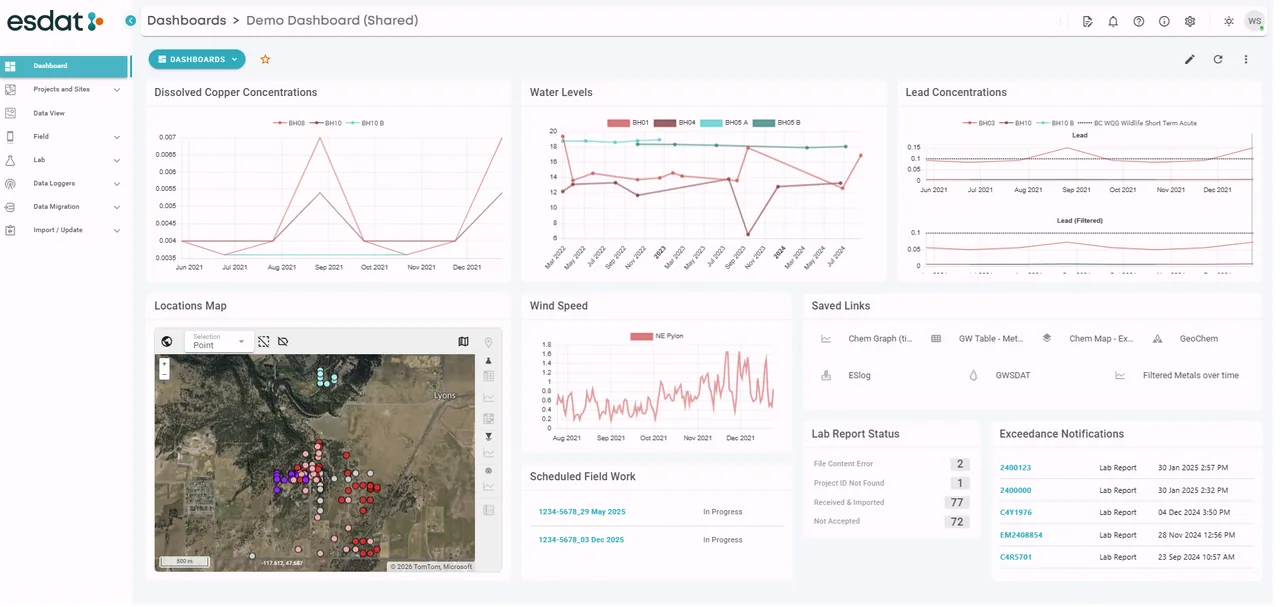
    ESdat dashboard with concentration and water-level charts, a locations map, saved links, lab report status and exceedance notifications

    Demo dashboard with charts, map and lab status

    Source
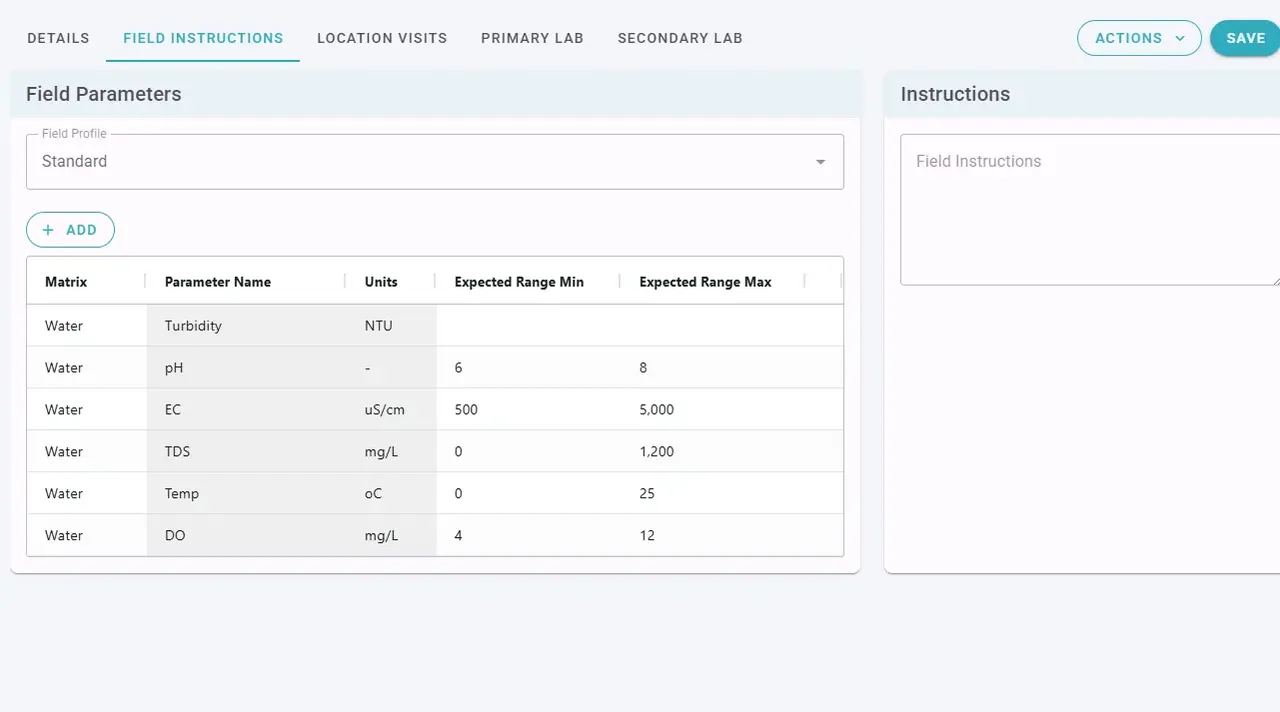
    ESdat tab with a field profile and a table of water parameters with units and expected minimum and maximum ranges

    Monitoring round field parameters tab

    Source

    Capabilities and scope

    ESdat is produced by EarthScience Information Systems (EScIS). This profile covers the current browser-based environmental data platform and its separately scoped Field Management, Field App, LabSync, LoggerSync, API/OData, Public Portal and Enterprise/Server options. Legacy ESdat Desktop migration support does not make Desktop the current evaluated product, and this is not a corporate ESG-reporting suite.

    ESdat capabilities, evidence status and source links
    CapabilityEvidenceScope and source
    Environmental data consolidationDocumented by vendor

    The official product scope covers laboratory, field-program, data-logger, sensor, historical and regulatory-standard data. Validate the exact schemas, units, qualifiers, identifiers and source ownership needed for each contracted data stream.

    ESdat product scope and reporting
    Field Management plans and monitoring roundsDepends on scope

    The Field Management module supports plans, recurring schedules, staff assignment, status notifications, review and approval of monitoring rounds. Confirm this module, co-scheduling rules, allowed deviations and approval roles in the proposal.

    Field programs and offline captureField Management module and monitoring rounds
    Offline field captureDepends on scope

    Offline capture is documented for the Field App, which is an upgrade from the online Field Portal. Laboratory sample details in the app require Field Management. This is not evidence that the rest of ESdat works offline; pilot preparation, conflicts, attachments and receipt after synchronization.

    Field programs and offline captureField Portal versus offline Field App scope
    Electronic chain of custody and laboratory requestsDepends on scope

    Field-program documentation covers electronic chain of custody, planned analyses and containers, lab-request review and matching collected sample details to laboratory data. Advanced eQuote and eCOC integrations are available only with selected laboratories, so prove the named laboratory path.

    Field programs and offline captureLaboratory integration, validation and LabSync scope
    Automated laboratory exchange and validationDepends on scope

    Approved laboratories can upload reports for validation and loading, with errors returned to the user and laboratory and revised results loaded as issued. Coverage, turnaround, mappings, original-file retention and support responsibility must be confirmed for every named laboratory and region.

    Laboratory integration, validation and LabSync scope
    Configurable field and laboratory QA reportsDocumented by vendor

    Official QA guidance lists frequency, field/interlaboratory/laboratory duplicates, blanks, spikes, surrogates, control and reference samples, inorganic checks, dilution factors and qualifiers. Results depend on correct sample typing, parent linkage and approved QA settings; the software does not decide fitness for use.

    Configurable environmental QA reportsDashboards, QA, maps, trends and reporting
    Laboratory approval, rejection and controlled revisionDepends on scope

    A Project Manager can approve or reject a lab report, with status, comments, date and approver shown. A later version cannot overwrite an approved report without rejection. Rejected results can still appear in data views unless filtered or deleted, so every operational and regulatory output needs an approved-data filter test.

    Laboratory report approval, rejection and revision rules
    Laboratory result edit historyDocumented by vendor

    Official guidance says edits to report details, samples and results record old and new values, date and person, including approval/revoke changes. Buyers should test export, retention and review of this history and distinguish an edit from a laboratory-issued replacement report.

    Laboratory report edit history
    Environmental standards and exceedance supportDepends on scope

    ESdat provides compiled regional standards, site-specific standards, action levels and exceedance outputs. Its Server guidance explicitly makes the user responsible for verifying compiled data, suitability and compliance, so validate publisher, version, effective date, matrix, basis, units, location association and jurisdiction before use.

    ESdat product scope and reportingOnline versus Server administration and standards responsibility
    Dashboards, tables, graphs and statistical outputsDocumented by vendor

    The reporting page documents customizable dashboards, chemistry exceedance tables, time-series graphs, trend analysis, common statistics and ProUCL export. Method selection, non-detect treatment, qualifiers and statistical interpretation remain specialist responsibilities.

    Dashboards, QA, maps, trends and reporting
    Maps and GIS exchangeDocumented by vendor

    ESdat documents map querying, Bing imagery, WMS/WFS and buyer basemaps, plus exports to ArcGIS, MapInfo and QGIS. Confirm coordinate reference systems, transformations, precision, layer permissions and completeness with surveyed control points.

    Dashboards, QA, maps, trends and reporting
    OData, API and analytics integrationsDepends on scope

    User OData feeds support Power BI, Excel, Power Automate, Power Query and ArcGIS; the non-user Enterprise OData feed is additional-fee, ArcGIS can require its Data Interoperability Extension, and the ESdat API has an additional annual fee. Confirm authentication, service accounts, schemas, rate/volume limits and change management.

    OData feeds and additional-fee Enterprise feedAdditional-fee ESdat API

    More capability notes

    4 additional areas. Status describes reviewed sources, not hands-on performance.

    Also watch for: Packages, modules and laboratory connections vary by region and proposal. Offline synchronization, conflicts and recovery need a representative field pilot. Guidelines, QA settings, ChemCodes, units and laboratory mappings require specialist validation. Rejected reports can remain in data views unless deliberately filtered or deleted.

    ESdat pricing

    Package or enterprise quote

    The packages page distinguishes regional consultant offerings, enterprise services and site-manager solutions. Obtain the relevant regional quote including field workflows, laboratory connections, migration and integrations. The official account-request page offers a free trial with support; duration and the modules enabled for your evaluation need confirmation.

    Pricing sources checked : Partially verified. No single cross-region starting amount is assigned; final pricing, trial duration and modules need confirmation.

    Which product scope should the quote cover?

    Core browser-based environmental data management and reporting, with Field Management, Field App, LabSync/advanced laboratory exchange, LoggerSync, API, Enterprise OData, Public Portal, Enterprise single-tenant and ESdat Server/custom database capabilities scoped and priced separately where applicable.

    Ask the vendor to identify the product, region, modules, billing unit, contract term and included services in writing.

    Offline work and integrations

    The ESdat Field App is documented to collect environmental field and sample data offline and synchronize with ESdat. The online Field Portal is a different scope, and laboratory sample information in the Field App requires Field Management. Pilot pre-download, ad-hoc additions, concurrent edits, conflicts, failed/partial sync and verified server receipt.

    What we could not verify

    9 depend on scope · 1 note

    Demo script

    Demo exercise: planned round to approved laboratory revision

    1. Create a representative recurring monitoring plan with locations, field parameters, QA samples, containers, analyses, assignees and an approval owner.
    2. Complete the round in the Field App while disconnected, add one permitted ad-hoc item, reconnect and reconcile every planned, collected, missed and extra record.
    3. Send the electronic chain of custody to the named test laboratory and import a result set containing an unmatched sample, unit issue, non-detect qualifier and deliberate QA failure.
    4. Reject the first report, import its corrected revision, approve it and prove that only the approved version appears in the selected operational and regulatory outputs.

    Demo exercise: QA decision and standards validation

    1. Load a controlled dataset with duplicates, blanks, spikes, surrogates, holding-time cases, dilution factors and qualified non-detects, retaining source values and units.
    2. Apply the buyer-approved QA profile and independently calculate each frequency, RPD, recovery and logic result.
    3. Associate a version-controlled environmental standard with the correct site, location, matrix and effective date, including one intentionally inapplicable limit.
    4. Have the environmental specialist document usability, qualifications and exceedance decisions, then compare tables, notifications and exports with the approved reference.

    Demo exercise: migration, permissions and auditability

    1. Prepare historical locations, wells, field chemistry and laboratory results containing duplicates, invalid references, missing required fields and an update that could overwrite a value with null.
    2. Run validation, resolve errors and import under a least-privilege account using the intended add, update or overwrite mode.
    3. Edit one laboratory result through the governed process and verify old/new values, actor, date, reason, approval state and retained source artifact.
    4. Test Admin, Scheduler, Standard and external-style accounts across restricted and unrestricted projects/sites, then reconcile every migrated and visible record.

    Ask the vendor to show you

    1. Which regional package, named-user licences, Field Management, Field App, LabSync, LoggerSync, API/OData, Public Portal, Enterprise or Server components are included and separately priced?
    2. Which named laboratories support basic upload, LabSync, eQuote and eCOC, and who owns onboarding, mappings, failures, revisions and support?
    3. Can we reconcile planned, collected, submitted, received and approved samples while keeping missed, duplicate, unmatched and rejected records visible?
    4. How are source values, units, detection/reporting limits, prefixes, qualifiers, dilution factors, batch IDs and laboratory files preserved through imports and exports?
    5. Which QA profiles implement our DQOs, and who approves sample types, parent links, frequencies, RPD/recovery limits, blanks, holding times, qualifiers and usability decisions?
    6. How are environmental standards sourced, versioned, dated, associated with matrix/site/location and independently verified before notifications or compliance outputs?
    Use demo checklist

    Questions the sources answer

    Is ESdat an ESG reporting suite?

    The reviewed offering focuses on environmental monitoring and site data. Corporate ESG framework coverage should not be inferred from that scope.

    Can ESdat collect field data offline?

    Yes, the vendor documents offline collection in its Field App. Demonstrate preparation and synchronization, and confirm which other functions need a connection.

    Are Field Portal, Field App and Field Management the same thing?

    No. The browser Field Portal is included with ESdat; the Field App adds offline operation, and laboratory-sample capture in the app depends on Field Management. Confirm all three elements needed by your workflow.

    Sources

    15 sources, checked

    Compare with

    Drawn from the profiles behind the Alternatives list above: most category tags shared with ESdat first, then the closest overlap in documented capability names, then A to Z. Ratings, search demand and sponsorship are not used; rows are shown A to Z.

    • EarthSoft EQuIS

      No shared category tag.

      Differs: scope ESG & Sustainability (this profile: Environmental Management); offline partial workflow (this profile: documented workflow); trial not established (this profile: free trial documented).

      Same: price.

    • NatureMetrics

      Shared category tags: 1 (Environmental Monitoring).

      Differs: scope ESG & Sustainability (this profile: Environmental Management); offline unclassified (this profile: documented workflow); trial on request (this profile: free trial documented).

      Same: price.

    • XNatura

      Shared category tags: 1 (Environmental Monitoring).

      Differs: scope ESG & Sustainability (this profile: Environmental Management); offline unclassified (this profile: documented workflow); trial not established (this profile: free trial documented).

      Same: price.

    All ESdat alternatives

    Reviews on qhsetech.com

    Star ratings and review counts from the old catalog are not shown: no source for them was recorded.