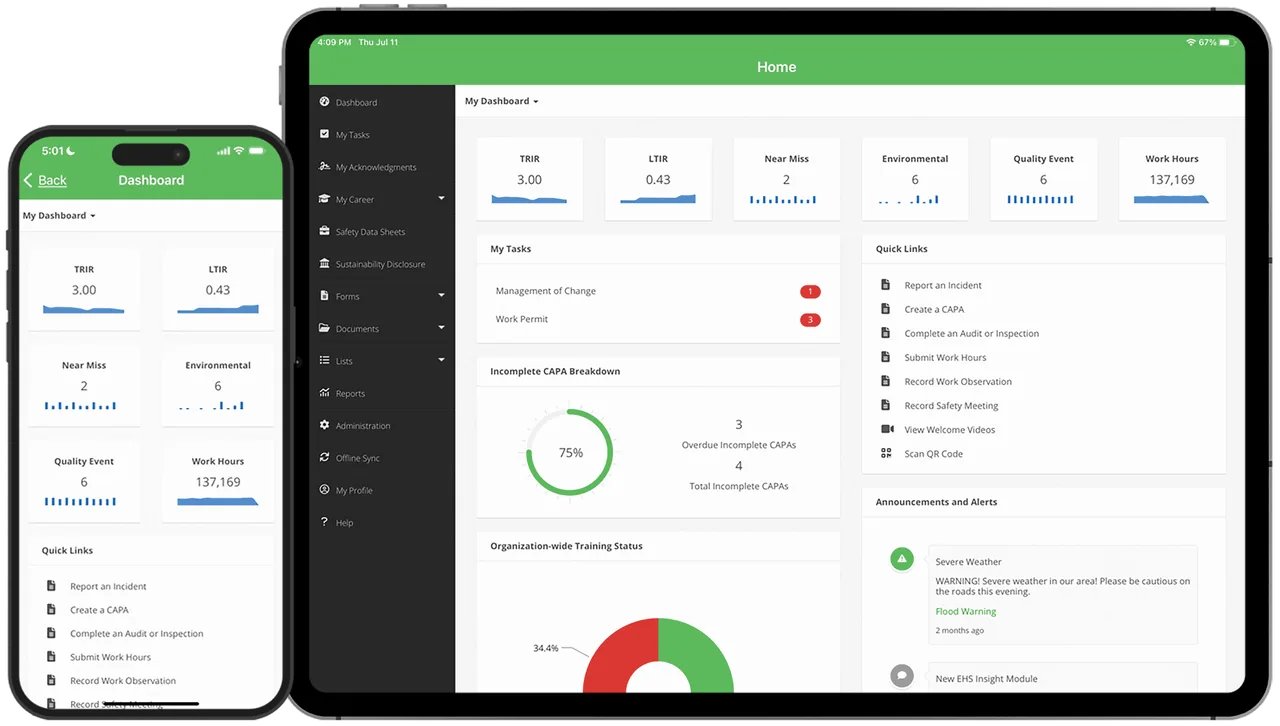
| Quality management and CAPA | Documented by vendor | The platform documents ISO 9001-oriented quality management, while the CAPA module connects incidents and nonconformities to root-cause analysis, assigned actions and follow-up. The reviewed quality solution brief identifies quality inspections, quality incidents, nonconformities and corrective actions but states that customer-feedback functionality is not included; confirm the required QMS breadth and closure controls. Platform scopeCAPA management and nonconformity workflow — checked 28 September 2026ISO 9001 solution brief and stated customer-feedback limitation — checked 28 September 2026 |
|---|
| Audit forms, offline execution and actions | Documented by vendor | The Audit Management module describes custom forms with required evidence and signatures, audit completion without internet followed by synchronization, actions created from findings, and reporting across teams or locations. The reviewed source does not establish a separate closure approver or effectiveness check. Audit Management module : checked 27 September 2026 |
|---|
| Offline inspections and incidents | Documented by vendor | Mobile capture and later synchronization are published; confirm preparation and recovery. Mobile capture and offline functions |
|---|
| Mobile actions and reference records | Depends on scope | The mobile page lists action tracking, SDS and training history. Verify records, permissions and purchased modules. Mobile capture and offline functions |
|---|
| Modular subscription | Depends on scope | Scope selected modules separately from the Enterprise bundle and support services. Official pricing and contract scope |
|---|
| Incident reporting, investigation and regulatory records | Documented by vendor | The Incident Management module covers initial reports and near misses, investigation and root-cause analysis, assigned corrective actions and documented follow-up. It also documents OSHA 300, 300A and 301 form support and records for injuries, illnesses, vehicles, property damage, spills and releases. These features organize regulatory data but do not establish filing accuracy, legal compliance, independent closure approval or corrective-action effectiveness. Incident reporting, investigation and OSHA recordkeeping moduleConstruction incident-to-resolution workflow |
|---|
| Training assignment and qualification visibility | Depends on scope | The Training Management module describes recurring or one-time assignments, company content or a training library, online and in-person formats, mobile history and requirement dashboards, QR verification and reports by employee, position, entity or requirement. Confirm content licensing, competency evidence, reminder rules and module entitlement. Training assignments, qualification tracking and reporting : checked 28 September 2026 |
|---|
| Compliance calendar, reminders and escalations | Depends on scope | The Compliance Management module centralizes permit renewals, inspections, report submissions and other recurring or one-time obligations. Tasks can be assigned by person, role or location, tracked on dashboards, exposed through reminders and escalations, and shared to Microsoft Outlook. Linked inspection or audit forms can be completed offline and synchronized later; confirm module entitlements and completion evidence. Compliance scheduling, reminders and offline task completionCompliance task assignment and calendar behavior |
|---|
| Chemical inventory, SDS and regulatory-data management | Depends on scope | The Chemical Management module stores material, CAS, composition, quantity, location, storage-condition and hazardous-property data, links SDS documents, and supports facility-level inventory and Tier II-oriented reporting. It does not automatically generate regulatory submissions, so buyers remain responsible for validation and filing. Chemical inventory, SDS and regulatory-data managementChemical management solution brief |
|---|
| Hazard identification and residual-risk management | Documented by vendor | The HIRA module records operational hazards, assigns risk owners, assesses likelihood and consequence, distinguishes inherent and residual risk, defines controls, tracks implementation and schedules periodic reassessment. Configuration supports the risk process but does not prove control effectiveness or policy acceptance of residual risk. Hazard identification, risk assessment and control trackingHazard and risk management solution brief |
|---|