IBM Envizi combines sustainability records from dispersed operations for analysis and reporting. Its data foundation supports multi-location organisations, while reporting and supplier modules address different collection and disclosure tasks.
Evidence: Researched profile
Built from vendor sources checked ; AI-assisted drafting. Documentation review, not a hands-on test. How pages are made
Organisations with multiple sites and reporting entities that need traceable sustainability records and controlled aggregation. The public estimator is planning guidance, not a formal offer, and Account-based sizing is not seat-based. IBM's GHG Protocol alignment and Built on GHG Protocol statements describe calculation resources; they do not replace the buyer's methodology decisions, controls, assurance or regulatory interpretation. AI/NLP can assist Scope 3 spend classification, but category, method, factor and currency choices still require review. Standard and custom factor selection, effective dates and any historical recalculation need documented governance; IBM states the client is ultimately responsible for factor correctness and calculated emissions. Supply Chain Intelligence focuses on purchased goods and capital goods and its Eora66 spend fallback requires USD product monetary value, while the broader Scope 3 accounting module describes coverage across all 15 categories. Emissions API, Excel calculations, Supply Chain Intelligence, target tracking and some reports or custom-factor functions must not be assumed included without entitlement and activation confirmation. Offline field collection was not verified.
Worth shortlisting when fragmented site data creates recurring reconciliation work. Compare the complete implementation and module quote against a representative reporting cycle before paying for capabilities beyond your current scope.
Published price: Indicative estimate EUR 57,314.21-80,042.26 per year excluding tax (Essentials, one sample configuration). Sources checked .
IBM Envizi ESG Suite is modular. Data management, Scope 1 and 2 accounting, Scope 3 accounting, ESG reporting, target tracking and Supply Chain Intelligence are separately described capabilities; the Emissions API is a distinct developer offering rather than a replacement for Envizi's governed accounting workflows. Confirm the contracted modules, Account volume and report activation instead of assuming every portfolio capability is included in Essentials. An Envizi Account is a data-tracking container, not a user seat. Centralized ESG data management and reporting with configurable Scope 1, 2 and 3 calculations, factor governance, disclosure workflows and optional target, supplier and developer calculation products.
IBM Envizi capabilities, evidence status and source links
Capability
Evidence
Scope and source
Data ingestion
Documented by vendor
File connectors, custom API integrations, forms and bulk templates are documented. Verify the exact source-system interfaces, frequency, error handling and implementation ownership.
Inputs can be normalized across calendar periods, units and currencies. Environmental calculations use normalized monthly data, so buyers should reconcile period allocation against source records.
Data can be grouped across sites, portfolios and cost centres. Validate the hierarchy against legal, operational and reporting boundaries and test historical reorganizations.
The framework reporting module manages questions, evidence, collaboration and reusable responses. Framework support does not guarantee disclosure completeness, regulatory compliance or external acceptance.
Reporting products include surveys and assessments for contributor data collection. Confirm the exact module, contributor access model, evidence retention and reminder workflow.
The named module calculates Scope 1 and 2 emissions using managed or custom factors and provides location-based and market-based reporting. Some reports require support activation and additional configuration.
Scope 3 accounting with AI-assisted spend classification
Depends on scope
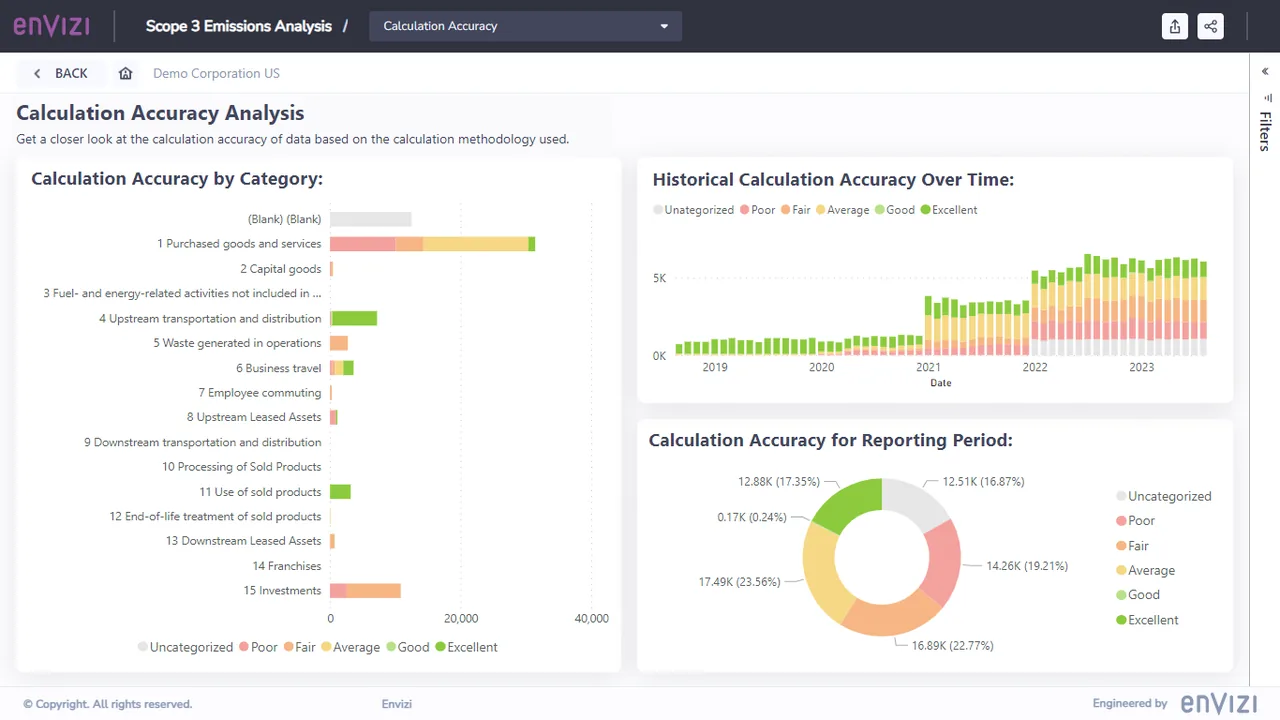
The Scope 3 module documents GHG Protocol calculation methods, embedded factor libraries, all-category coverage and NLP-assisted categorization for spend calculations. Treat AI output as a reviewable classification, not verified accounting evidence.
IBM documents the sequence from captured activity data through transformation, monthly normalization and standard or custom factors to calculated outputs. Account styles, units, region, subtype, factor set and effective dates influence results.
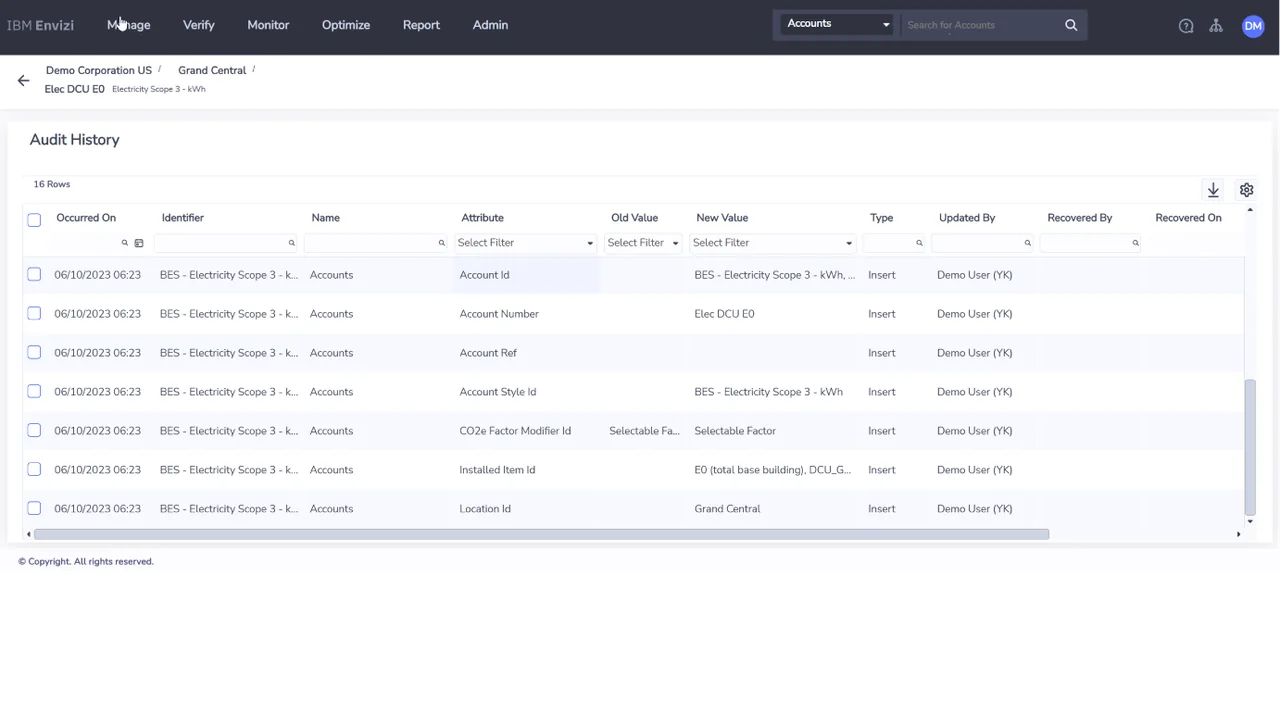
IBM-managed factor review, effective dates, conflict checks and audit reports are documented. Custom Factor Management and some reports may require support activation; IBM states the client remains ultimately responsible for factor correctness and calculated emissions.
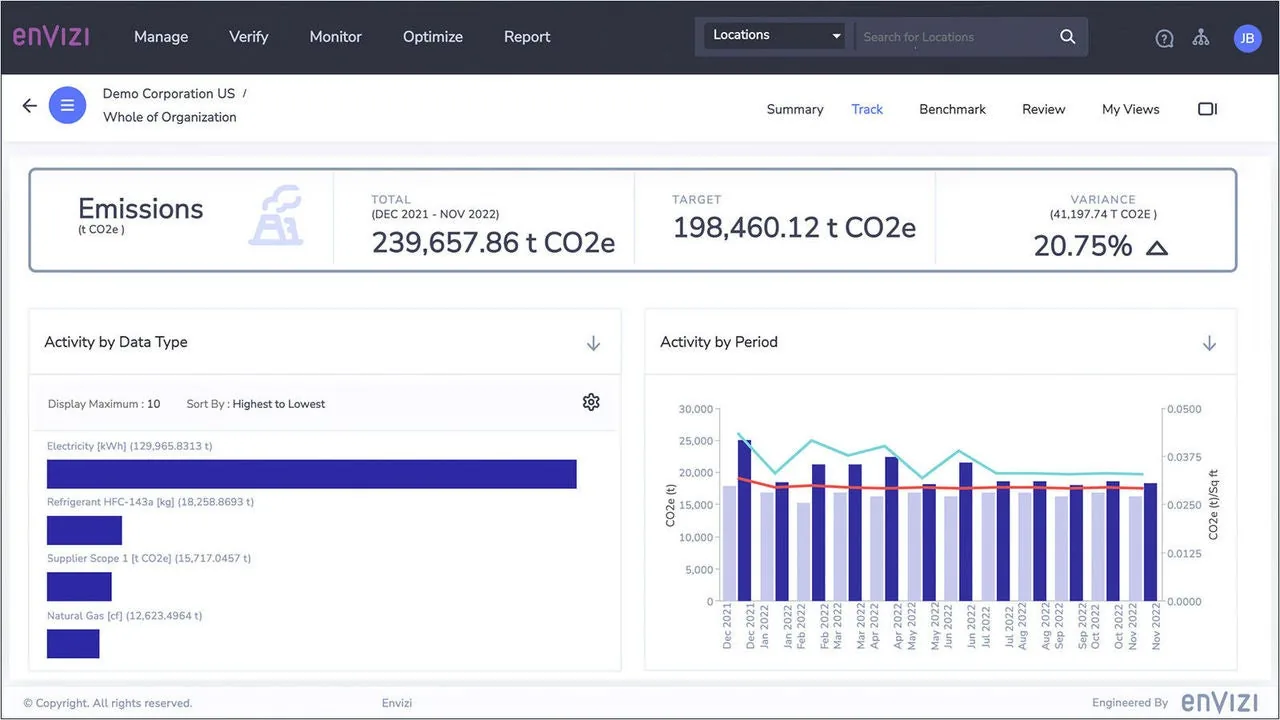
A named module supports energy, cost, emissions and intensity targets with rate-analysis and performance dashboards. Confirm entitlement and demonstrate baseline changes, organizational changes and recalculation rules.
Supply Chain Intelligence focuses on Scope 3 categories 1 and 2 and can prioritize supplier data with average- or spend-based fallbacks. It is a separately scoped module, not proof of coverage for every Scope 3 category.
The supplier workflow can trace calculated order-line emissions to supplier PCF or fallback factors. IBM documents that Eora66 MRIO fallback factors are USD-based and require product monetary value and currency in USD for the calculation to work correctly.
2 additional areas. Status describes reviewed sources, not hands-on performance.
Also watch for: Final subscription requires a scoped quote. Integration setup and data preparation need evaluation.
IBM Envizi pricing
Quoted subscription by data volume and functionality, with a public price estimator
On 26 September 2026 the pricing page's estimator, for Manufacturing, 10 facilities, greenhouse gas reporting with Scope 1 & 2 but not Scope 3, and ESG framework disclosures, recommended the Essentials package and showed an estimated yearly price range of EUR 57,314.21 to EUR 80,042.26, or EUR 4,776.18 to EUR 6,670.19 monthly, excluding tax. The page says estimates are for planning only, may reflect IBM discounts and are not a formal offer from IBM or an IBM Business Partner; they assume a minimum 12-month term and vary with configuration, add-ons, country and local currency, and Business Partners set their own prices. Bundles are Essentials up to 1,000 data Accounts, Standard 1,001-5,000 and Premium 5,001-15,000+; Accounts are data-tracking units, not user seats. Obtain a formal quote for your own industry, facility count and modules before budgeting.
Pricing sources checked : Partially verified. On 26 September 2026 the public estimator showed an indicative yearly range for one stated configuration, and the Account bundles and estimate conditions were rechecked. The estimate is not a formal offer; a final amount requires a quote.
Offline workflow unverified
Do not assume disconnected field inspection support; ask for a demonstration of any proposed offline workflow.
What we could not verify
1 not verified · 8 depend on scope · 2 notes
Not verified in the sources: Offline field collection.
Do not assume so. IBM presents emissions accounting, Scope 3, supply-chain intelligence, reporting, targets, API and other capabilities as modules or offerings. Require a line-item entitlement list and report-activation matrix in the proposal.
Does Envizi's GHG Protocol alignment guarantee compliant reporting?
No. The product documentation describes calculation resources built on or aligned with GHG Protocol methods, but the buyer remains responsible for organizational boundaries, methods, factors, controls, disclosures and any assurance or legal conclusions.
Can Envizi calculate Scope 3 emissions?
The Scope 3 accounting module documents coverage across all categories and AI-assisted spend classification. Supply Chain Intelligence has a narrower purchased-goods and capital-goods focus. Confirm which product, categories and methods are contracted.
Does AI remove the need to review Scope 3 classifications?
No. IBM documents NLP-assisted categorization for spend data. Buyers should test ambiguous descriptions, review overrides and retain approval evidence for category, method and factor choices.
How are emission factors governed?
IBM documents managed factor review, effective dates, audit reports and optional custom-factor management. Some functions require activation, and IBM states the client is ultimately responsible for the factors used and emissions calculated.
What currency boundary applies to Supply Chain Intelligence spend fallbacks?
IBM's audit-trail documentation says its Eora66 MRIO fallback factors are based on US dollars and the product monetary value and currency must also be USD for the calculation to work correctly. Test the conversion and provenance process with real purchasing data.
Is the Envizi Emissions API included in the ESG Suite subscription?
Do not assume it is. IBM presents the API as a separate developer offering with its own plans and says it is not a replacement for governed Envizi accounting workflows. Confirm commercial entitlement, factor datasets and reconciliation controls.
Can Envizi support several ESG reporting frameworks?
The framework module supports response reuse, evidence and document exports. Have the reporting team test a representative framework and evidence package; the software does not guarantee completeness or acceptance.
: Recorded the indicative yearly range the vendor price estimator showed on 26 September 2026 for one stated configuration (EUR 57,314.21 to 80,042.26, Essentials), replacing the note that no amount was verified.
No independent numeric rating, certification or guaranteed compliance is asserted.
Related
Alternatives
Researched ESG & Sustainability Reporting profiles matched on shared categories, offline status and pricing model, listed alphabetically.
Categories describe the product or separately scoped applications.
Appears in these guides
Each guide lists IBM Envizi under its published rule, in documented-match order. That order reflects documentation, not quality; no product is recommended.
Drawn from the profiles behind the Alternatives list above: most category tags shared with IBM Envizi first, then the closest overlap in documented capability names, then A to Z. Ratings, search demand and sponsorship are not used; rows are shown A to Z.