QHSE Software Price Transparency: What the Records Show
By Dimitris Mitsios · Dimitris works at Tekmon, which pays for sponsored placements on this site. Disclosure · AI-assisted (how pages are made)
77 of 209 researched products have a current public amount on record; 132 have no current paid amount. See the evidence and pricing conditions.

Our pricing index records what public sources establish about the researched QHSE and EHS products. It separates an amount that can inform a buying conversation from a complete price for the configuration you need.
77 of 209 researched products (37%) have a current public amount on record; 132 (63%) have no current paid amount on record. Pricing observations: 28 Sep – 3 Oct 2026.
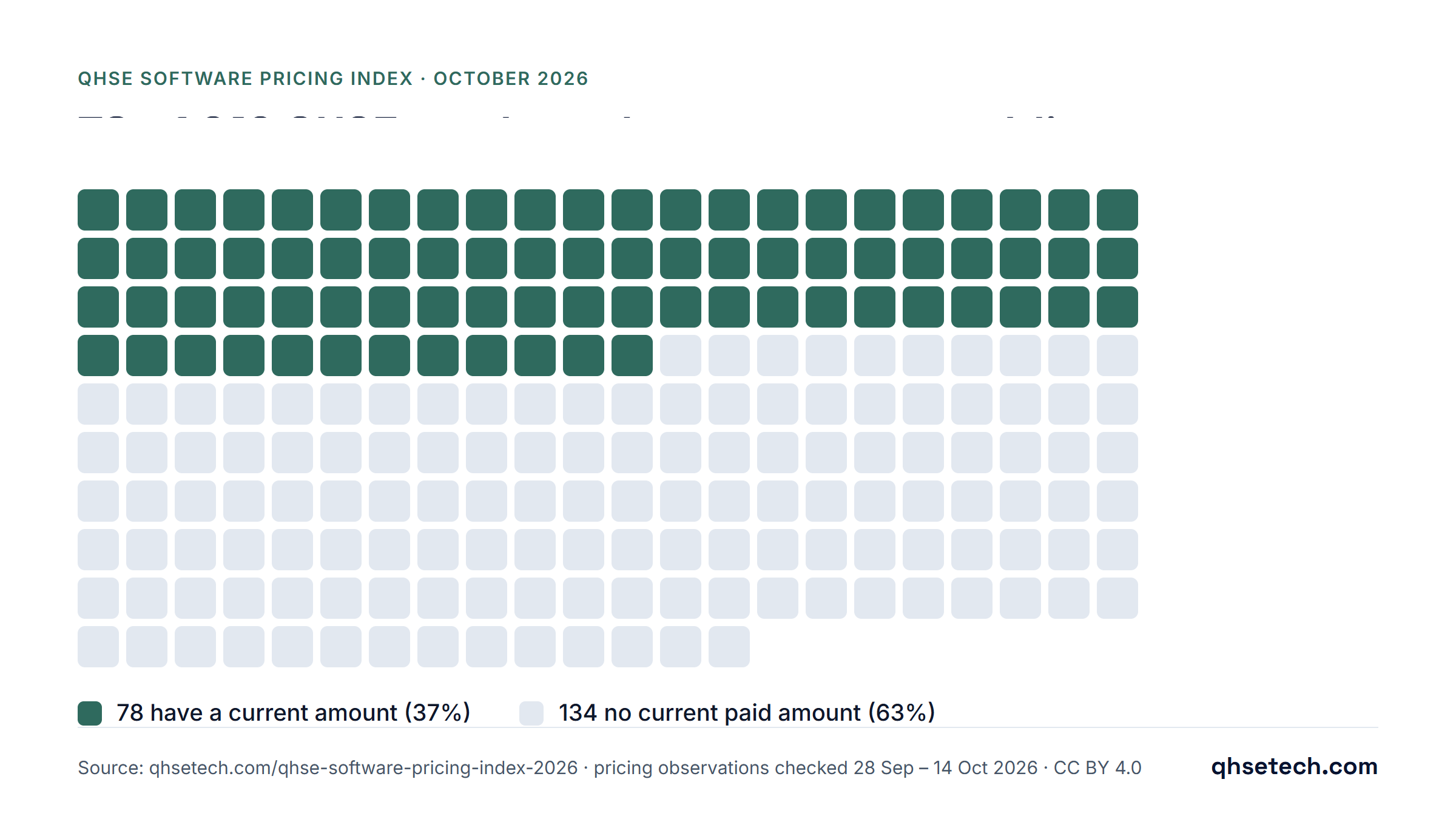
No current paid amount on record is not the same finding as “quote only on request.” The Industry Report distinguishes reviewed pages showing no amount, records with an older amount that is not current, and free plans without a paid amount. The QHSE Software Pricing Index links each dated record and its source. None of these observations establishes why a vendor prices this way or how quickly it will answer a buyer.
This post is about what the pattern in that data tells you. Its companion, How Many QHSE Vendors Publish a Price?, goes the other way: it takes the vendors that do publish an amount and counts what the amount is charged on (user, site, module). Read this one for how to interpret a missing or conditional price, and that one for the unit counts.
Transparency divides by what the software does
The researched categories differ in how often a current amount is on record. These are descriptive counts for this catalogue, not proof that a sales model or company size causes the difference.
| Category | Current amount on record | Share |
|---|---|---|
| Audits & Inspections | 14 of 15 | 93% |
| Asset Management | 5 of 7 | 71% |
| Quality Management | 8 of 22 | 36% |
| EHS Management | 12 of 43 | 28% |
| ESG & Sustainability | 3 of 30 | 10% |
The table and charts use the same observation data as the index. The category chart omits groups below its stated sample floor; a small category should not be treated as a market estimate.
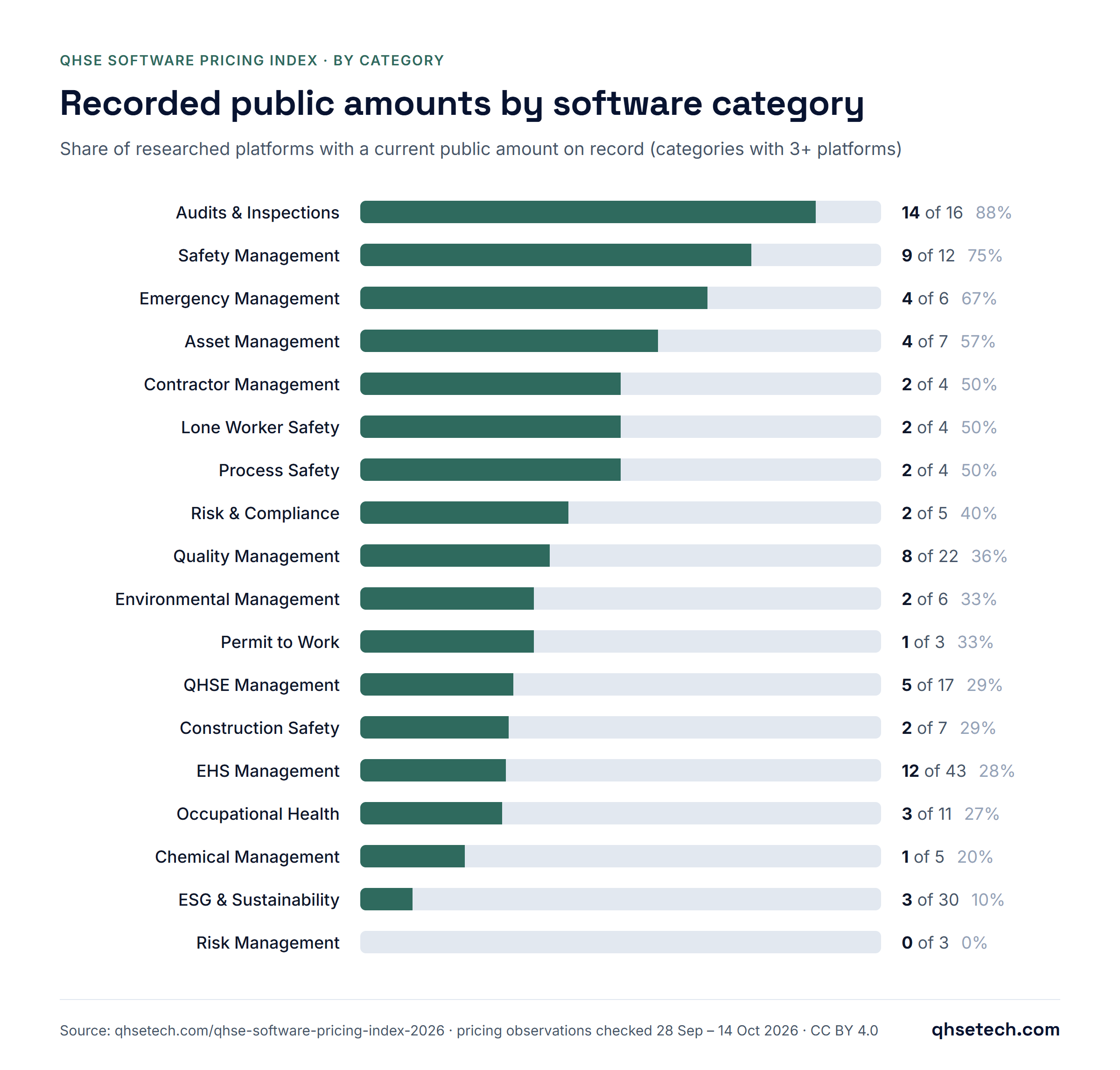
Both charts are free to reuse under CC BY 4.0 with attribution to qhsetech.com; the pricing index has the underlying rows.
Several field and inspection tools publish per-seat rates. That gives a buyer a starting calculation, but minimum seats, billing terms and the permissions of each role still affect the cost.
Enterprise EHS and ESG proposals can depend on applications, sites, integrations and implementation. Where the record has no usable amount, keep budget suitability unresolved and request a quote for a shared specification. You can still shortlist by documented workflow scope before receiving that quote.
Even a counted amount may be an estimator's indicative range for a sample configuration rather than a list price. Follow the linked record to understand what the amount describes before using it in a budget.
What we deliberately do not publish
No average. No median. No "typical cost of QHSE software" figure.
The recorded amounts use incompatible units:
- per user per month
- per tenant per month
- per site per month
- per emission unit per year
- flat annual licence for a named user cap
They are stated in five named currencies (US dollars, euros, pounds sterling, Indian rupees and Australian dollars), and many carry only a dollar sign. Our profile for GoCanvas, for example, records that its packages page does not establish which dollar it means.
Averaging across that produces a number with the appearance of authority and no defensible meaning. If you have seen a headline "average QHSE software price", it is worth asking what population it was calculated over and whether the units were the same.
What the index consistently records is whether a current public amount was established, together with the amount's conditions and evidence date. That is a transparency measure, not a cost ranking.
The published prices come with conditions
For products with a recorded amount, the headline rate may not be the minimum subscription cost. These examples illustrate why the terms matter. Each amount below was read again from the vendor page on 4 October 2026 and matches the dated record in the index; check the linked record before budgeting:
- Appenate: USD 20 per user per month billed annually, five-user minimum (pricing page)
- Fulcrum: US$43 per user per month on an annual subscription, minimum five users; five users at US$43 is a floor of US$215 a month (pricing page)
- GoCanvas: per-user tiers from 29 a month, billed annually, with a three-user minimum; the reviewed page did not establish the currency (packages page)
- Intelex: US$44 per user per month for Safety Essentials, minimum 25 users, billed annually (pricing page)
- Workhub: USD 3 per user per month, minimum three users, billed month to month (pricing page)
For a team of four, the real question is not the seat price. It is whether the vendor will sell to a team of four.
Several of these plans are billed annually (Appenate, Fulcrum, GoCanvas and Intelex among them). For those, a realistic first-year figure is the minimum seat count multiplied by the seat price multiplied by twelve, before implementation, migration or any module that turns out to be extra. For example, Intelex's 25-user minimum at US$44 comes to US$13,200 for the first year.
The table applies that arithmetic to the five examples above. It shows only the entry tier at its stated minimum, so it is a floor under the vendor's own terms and not a price for any real team.
| Product (entry tier as published) | Seat price | Stated minimum | Floor for 12 months |
|---|---|---|---|
| Workhub Standard | USD 3 a month, month to month | 3 users | USD 108 if kept for a year |
| GoCanvas Essentials | 29 a month, currency not established, billed annually | 3 users | 1,044 in the displayed currency |
| Appenate Standard | USD 20 a month, billed annually (USD 240 a year) | 5 users | USD 1,200 |
| Fulcrum Professional | US$43 a month, annual subscription | 5 users | US$2,580 |
| Intelex Safety Essentials | US$44 a month, billed annually | 25 users | US$13,200 |
Two cautions on reading it. The floors are not comparable with each other, because the products cover different jobs: a form builder, a field-data platform and an application bundle that includes incidents and inspections. And a floor is the smallest purchase the vendor's own terms allow, not the cost of the team you actually have; add the users above the minimum, any add-on the workflow needs, taxes and set-up. The site also lists alternatives to Intelex and alternatives to GoCanvas for readers who want to see other documented options.
Free tiers have limits worth reading
Several vendors offer genuinely free plans, and the limits are worth reading before you build a year of habits on one:
- Clappia: free plan up to 100 users, capped at 400 submissions and 400 workflow step executions a month (pricing page)
- Fieldwire by Hilti: a free Basic plan limited to 5 users, 3 projects and 100 sheets, alongside paid plans (pricing page)
- Mitti (by SafetyCulture): free plan for 10 active users, unlimited inspections, but only five active templates (plan limits)
Our research records those limits. It did not establish which follow-up workflows each free plan includes: incident investigation, corrective action with a reviewer, compliance reporting. Test those steps on the free plan itself, not on a trial of a paid tier. Two of the products above, Clappia and GoCanvas, also have a side-by-side comparison page.
That matters more than it sounds. The common failure is adopting a free inspection tool, building templates and habits on it for a year, and then discovering at the first customer audit that the thing being asked for — an investigation with a corrective action someone else reviewed and closed — was never in that plan.
Questions to put to a vendor whose price is not public
These are requests for information, and a vendor may reasonably decline some of them before a scoped conversation. The answers still belong in your comparison file, next to the date they were given.
- Which pricing metric will the quote use: named users, concurrent users, sites, modules, or data volume? Ask for the definition of one unit in the vendor's own words.
- Which roles are charged? A reviewer, a contractor with a guest login and a person who only submits a report may be priced as three different seat types, or not charged at all.
- Can the vendor send an indicative range for your stated scope before a demo, even if it is labelled non-binding? A refusal is a fact to record, not a score.
- Is the trial or sandbox the same tier you would buy? Ask which modules, integrations and limits differ between the two.
- If a free plan is offered, what happens to records when you cross its limit: are they kept read-only, exported, or restricted?
- Which items in your specification are outside the base subscription and priced separately, such as integrations, extra storage, sandbox environments or implementation hours?
Keep the wording identical across vendors. The demo checklist and the RFP template carry the same kind of items in a form you can send to every vendor.
Frequently asked questions
Does a missing price mean the software is expensive?
No. The research records whether a current public amount was established, not what the product costs. A missing amount can mean configurable scope, a page that could not be read, or a quote-based sale, and the records do not say which.
Why are the counts here different from older versions of this article?
The counts are read from the dated observations in the pricing index each time the post is built, so they move when an observation changes. Earlier totals, listed in the revision record, should not be reused.
Can I use the free plans of the products named above for compliance records?
The research did not establish which follow-up workflows each free plan includes. Test the specific workflow, for example an investigation with a reviewed corrective action, on the free plan itself before relying on it.
Where can I see the amount and the source for a single product?
Open its row in the pricing index or its profile under software profiles. For a worked method of turning a published price into a first-year figure, see the pricing guide.
What to do with this
If your shortlist is field tools, you can compare list prices before you talk to anyone. Use the index, check the minimums, and price the reviewer seat specifically — full, lite and guest seats differ, and a guest seat described as free usually cannot close an action.
If your shortlist is enterprise EHS or ESG, accept that price discovery is a procurement exercise and plan the time. Send every vendor the same written specification — users by role, applications named individually, sites in scope, contract currency, billing term — because the reason three quotes are hard to compare is usually that they were priced for three different things.
In both cases, do not read a missing price as a high price. It is not evidence of cost. It is evidence that comparison takes work, which is a cost of a different kind, and it is the one this data actually measures.
Method
The population is the 209 products in our researched catalogue. That is not a census of the QHSE and EHS market, and inclusion reflects what we have researched rather than market share.
The aggregate pricing observations cover 28 Sep – 3 Oct 2026. The observation date is recorded per product, separately from this article's revision date. No vendor was contacted and no quote was requested for this research. Updating the aggregate figures does not mean every individual source was rechecked that day.
The Published-price rule counts an amount quoted from a vendor page or another public listing unless the evidence calls it legacy, unverified or not current. A free plan alone does not count as a paid amount. A recorded amount may still lack a stated currency, billing period or complete package scope. Amounts are recorded verbatim and are not converted or normalised; a counted amount is not a quote for your intended scope.
The full dataset is CC BY 4.0 and free to cite, reproduce or embed with attribution. CSV and JSON exports are on the index page.
Tekmon is a commercial partner of The QHSE Standard. It is included in the counts above on the same basis as every other researched platform and is not used as a price example. See our methodology and commercial disclosures.
Sources
- The QHSE Standard: QHSE Software Pricing Index 2026, the dated per-product observations behind every count and chart in this post
- Vendor pricing pages, read again on 4 October 2026 (the index holds each product's own observation date): Appenate, Fulcrum, GoCanvas, Intelex, Workhub, Clappia and Fieldwire
- Mitti help centre: Free versus Premium plan limits
Revision record
Revised 4 October 2026: the vendor examples were re-read against the vendor pages, a first-year floor table, a vendor question list and an FAQ were added, and the companion data article was linked. The counts and category table are generated and were not edited by hand.
Corrected 29 September 2026: the former title, “Two Thirds of QHSE Vendors Won't Publish a Price,” inferred vendor intent from missing amounts. The earlier “53 publish / 101 quote only” wording also combined distinct evidence statuses. Both claims are withdrawn. The current summary, category table and chart descriptions now read the same observation data as the pricing index, while the method distinguishes a public amount from a complete quote.
Earlier corrections, 22–26 September 2026: category spelling variants were combined, legacy or unverified amounts were excluded, an amount without a stated currency was included under the published rule, and subsequent vendor-source checks changed the counts. Unsupported named-vendor claims were removed or narrowed. Historical totals from those revisions should not be reused as current findings; use the dated records linked above.

Founder of The QHSE Standard; product marketing at Tekmon
Dimitris Mitsios is the founder of The QHSE Standard and works in product marketing at Tekmon. His professional focus includes software positioning, digital workflows and user adoption.
Dimitris works at Tekmon, which pays for sponsored placements on this site.
Researched and drafted with AI assistance and published under the author's editorial responsibility (how pages are made). Found an error? Send a correction with a source.
Related software
Browse all platforms →Tekmon pays for sponsored placements on this site; its place in this list follows the same rule as every entry. How lists are ordered
- EHS Management
Intelex
EHS Management
Read the profile - ESG & Sustainability
Microsoft Sustainability Manager
ESG & Sustainability
Read the profile - QHSE Management
Tekmon
EHS Management
Read the profile